Casals Calling is a feature film based on a true story, with historical and documentary elements. Spanning more than three hundred years of music and history, it explores the full sweep of Pablo Casals’s life and his enduring connection to Johann Sebastian Bach, whose music lies at the heart of the Western classical tradition.
A chance discovery of Bach’s Six Suites for Solo Cello at thirteen helped shape the life of an artist who would transform the voice of the cello. Through triumph and personal struggle, exile and resistance, Casals’s devotion to Bach remained a constant. His leadership, his protest, and the power of his chosen silence reveal a life in which music and conscience were inseparable.
At its heart is the extraordinary world of Bach’s music: its spiritual depth, profound humanity, and capacity to speak across generations. Casals’s ideals of peace, freedom, and human dignity give this living legacy a continuing presence in the events of our time—and in the lives of those who will carry it forward.
At Prince Leopold’s court in Köthen, Johann Sebastian Bach’s work centered on instrumental music. It was here that he is believed to have composed his Six Suites for Solo Cello, BWV 1007–1012. Their precise date of completion remains uncertain, and his original manuscript has not survived. The music reaches us through handwritten copies, including one made by his wife, Anna Magdalena Bach.
Yet through dance, counterpoint, implied harmony, and silence, Bach makes a single cello speak with the breadth of an entire musical universe. Uniting technical mastery, spiritual insight, and profound humanity, the Suites create a living connection between composer, performer, and audience that spans the arc of time.
1824 — The first printed edition, prepared by cellist Louis-Pierre Norblin and published in Paris by Janet et Cotelle, appeared nearly seventy-five years after Bach’s death. Presented as ‘Sonatas or Studies,’ the Suites remained largely outside the concert repertoire.
c. 1890 — At thirteen, Pau Casals discovered Friedrich Grützmacher’s edition in a secondhand music shop in Barcelona. He studied the Suites for thirteen years before performing them publicly, beginning a lifelong mission to reveal their profound musical importance.
1936–1939 — Approaching sixty and after decades of study, Casals made the first complete commercial recording of the cycle. He recorded Suites Nos. 2 and 3 at Abbey Road Studios in London on November 25, 1936; Nos. 1 and 6 in Paris on June 2–3, 1938; and Nos. 4 and 5 in Paris on June 13–16, 1939. Recorded in monaural sound and issued on 78-rpm discs on the His Master’s Voice (HMV) label, then part of EMI, the landmark cycle helped establish the Suites at the heart of the cello repertoire. In 2019, it was selected for preservation in the Library of Congress’s National Recording Registry.
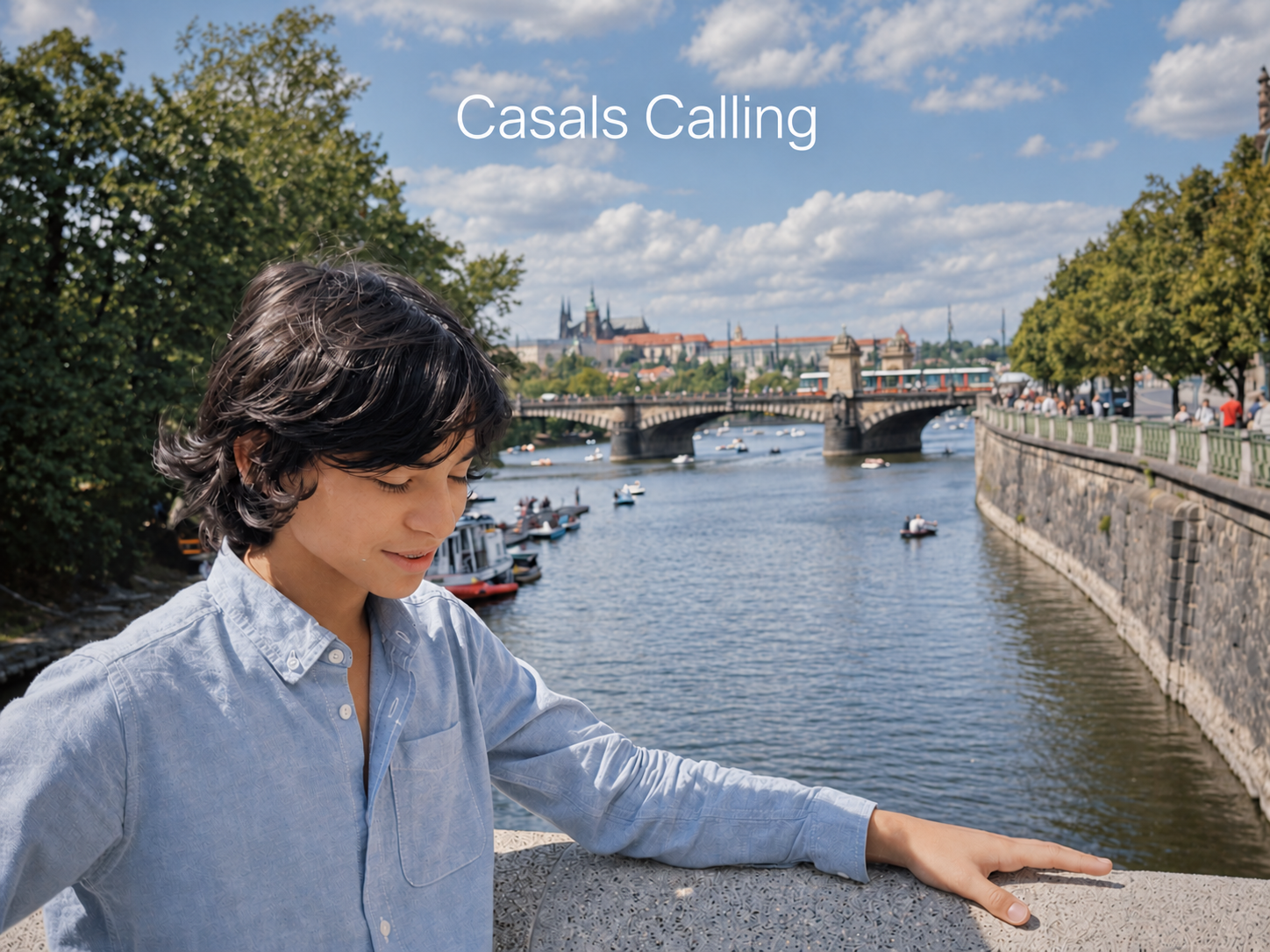
Prague, Czech Republic· August 2023
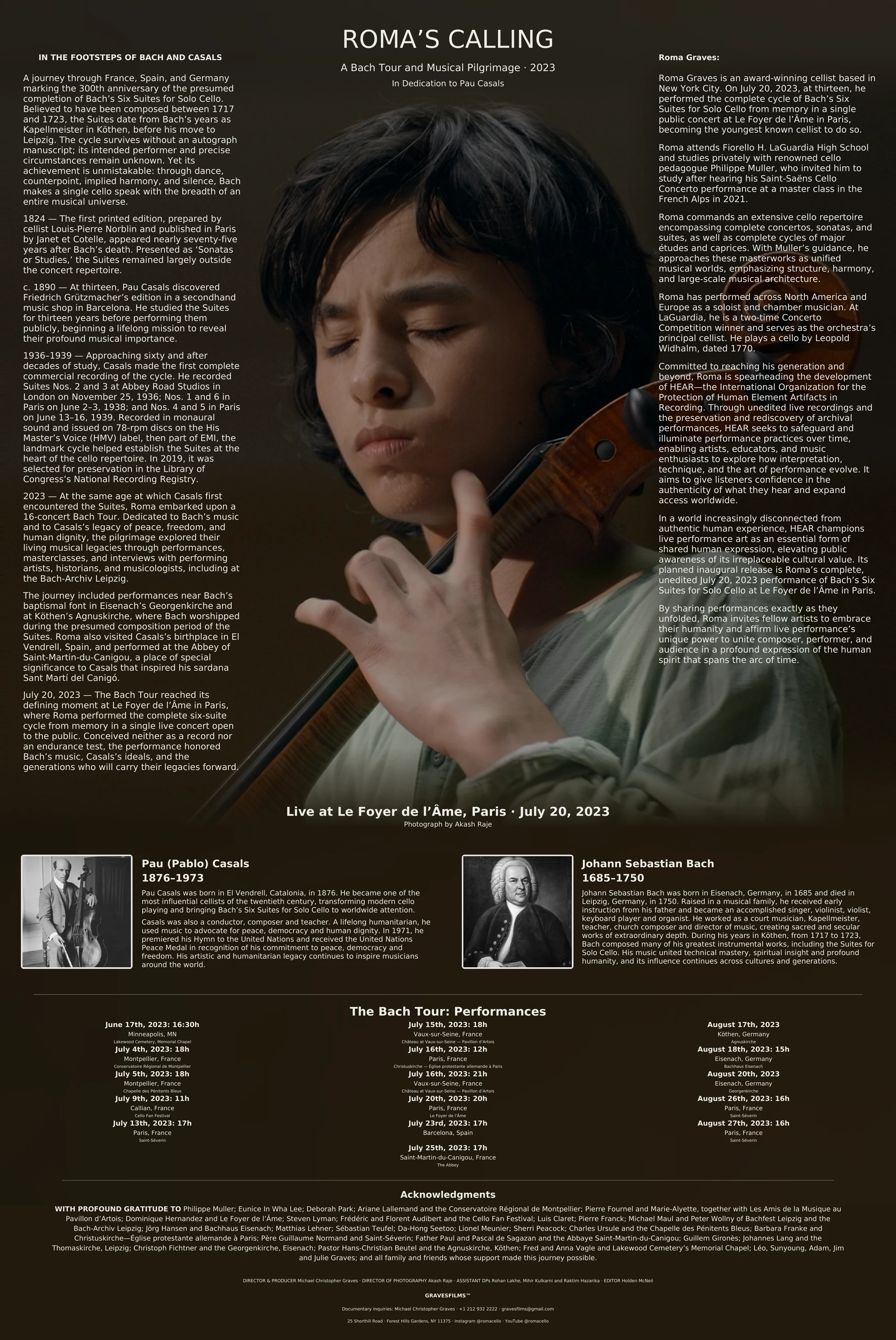
2023 — At thirteen—the age at which Casals first encountered the Suites—Roma Graves set out on a 16-concert Bach Tour through France, Spain, and Germany. Dedicated to Bach’s music and to Casals’s legacy of peace, freedom, and human dignity, the pilgrimage traced a living connection between composer, performer, and audience. Through performances, masterclasses, and interviews with performing artists, historians, and musicologists, including at the Bach-Archiv Leipzig, Roma sought a deeper understanding of the music and the lives that have carried it forward.
The journey included performances in Callian and at Saint-Séverin in Paris; near Bach’s baptismal font in Eisenach’s Georgenkirche; at Köthen’s Agnuskirche, where Bach worshipped during the presumed composition period of the Suites; and at the Abbey of Saint-Martin-du-Canigou, a place of special significance to Casals that inspired his sardana Sant Martí del Canigó. Visits to places central to Bach’s and Casals’s lives—including Casals’s birthplace in El Vendrell, Spain, and the Bach-Archiv Leipzig—deepened Roma’s understanding and appreciation of their living musical legacies.
July 20, 2023 — The pilgrimage brought Roma to Le Foyer de l’Âme in Paris, where he performed the complete six-suite cycle from memory in a single public concert. The performance honored Bach’s music, Casals’s ideals, and the generations who will carry their legacies forward.
For Roma, a young artist still discovering his own voice, the pilgrimage is also a search for his place within this living tradition. He seeks to join a community of twenty-first-century torchbearers, drawn together by a devotion to the music and a desire to carry its humanity into the future. What that inheritance will ask of him—and what he may bring to it—remain to be discovered.